

Printed and organic electronics » Innovative everyday heroes

What is Printed Electronics? – A Definition
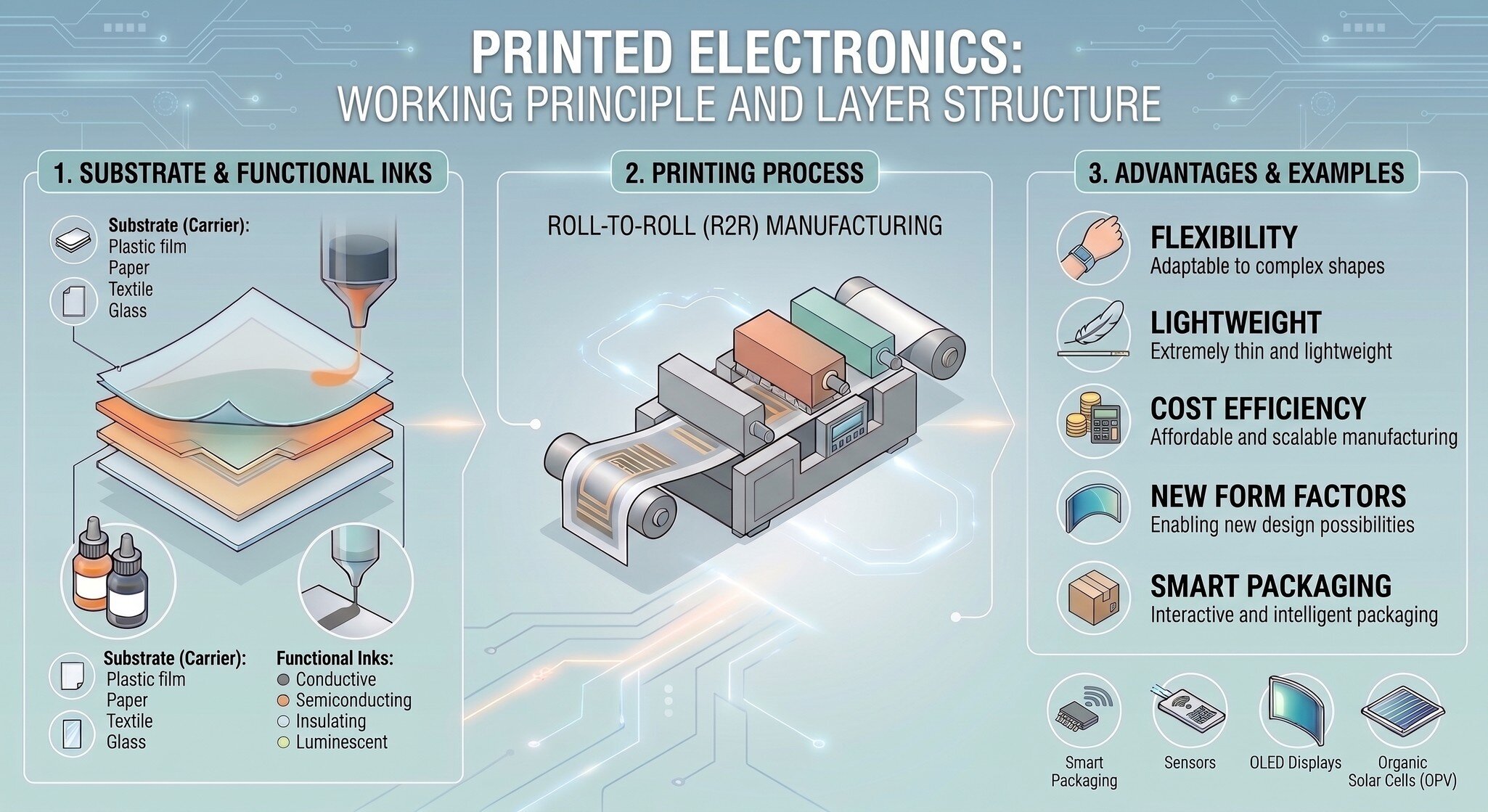
Printed Electronics describes a revolutionary manufacturing process where electronic components are no longer rigidly etched onto circuit boards, but applied onto various substrate materials using classic printing techniques.
Instead of conventional inks, functional inks are used. These consist of conductive, semiconducting, or insulating materials (such as organic polymers or nanoparticles) that unfold their electrical function immediately after printing.
The Principle: From Graphic Printing to High Technology
The process resembles newspaper printing, but with a decisive difference in outcome:
- The Substrate (Carrier): Instead of rigid PCBs, flexible materials such as plastic films, paper, glass, or textiles serve as the base.
- The Printing Process: Proven methods such as screen printing, inkjet printing, or roll-to-roll (R2R) processing apply functional layers with high precision.
- The Function: Layering different functional materials creates complex components such as sensors, transistors, displays, or organic photovoltaics (OPV).
Why is this groundbreaking?
Unlike traditional semiconductor manufacturing, flexible and printed electronics enables additive manufacturing. This means material is applied only where it is actually needed. This saves resources, drastically reduces production costs for large volumes, and enables entirely new form factors.
The result is electronics that are bendable, transparent, extremely lightweight, and cost-effective enough to be used even in disposable products such as smart packaging or medical patches.
Why Printed Electronics? The Future is Flexible.
- Thin, Lightweight & Flexible: Integrate electronics where conventional silicon components reach their limits. Printed parts are ultra-thin and adapt to any surface or shape — ideal for wearables or curved automotive interiors.
- Cost-Efficient Mass Production: Leverage established printing techniques such as roll-to-roll for high-speed, large-area manufacturing. Reduce material waste and benefit from highly scalable processes.
- Focus on Sustainability: Printed electronics enables the use of organic materials and reduces the environmental footprint through lower production energy demands and improved recyclability.
- Seamless Integration: Transform passive surfaces into smart interfaces. Direct integration of sensors, displays, and antennas into textiles, paper, or plastics opens up entirely new product designs.
From Sensor to Display: The Portfolio
- Printed Sensors & Actuators
- Displays, Lighting & Smart Surfaces
- Printed Circuits & Components
- Flexible Energy & Batteries
- Wireless Communication
Why Make the Switch Now?
Integrating flexible and printed electronics allows manufacturers to reduce weight, streamline production steps, cut costs, and realize completely new product designs that radically improve user convenience and functionality.
FAQ´s
1. Relevance & Business Value
Printed and flexible electronics enable entirely new products that are lighter, thinner, more flexible, and often more cost-effective than conventional solutions. The technology unlocks functions and form factors that are difficult or impossible to achieve with traditional electronics. Companies increasingly use it to differentiate through innovation, simplify components, reduce weight and material costs, and meet sustainability goals.
Flexible and printed electronics is no longer a niche for the electronics sector alone. Key driving and user industries include:
- Automotive: Smart surfaces, integrated sensors, lightweight construction
- Healthcare & Mediacl: Medical sensor patches, wearables, electronic skin (E-Skin)
- Packaging & Logistics: Smart packaging, intelligent labels, supply chain tracking
- Consumer Electronics: Foldable displays, smart controls
- Other Sectors: Industrial automation, smart home, sports & lifestyle, building automation, and energy harvesting.
In most cases, it acts as an ideal complement. While silicon remains unmatched in processing power, printed electronics excels in large-area applications, mechanical flexibility, lightweight design, and low-cost sensing. In practice, hybrid systems combining the best of both worlds are the dominant approach.
2. Applications, Market Readiness & Reliability
Numerous applications are already in global high-volume series production, including:
- RFID/NFC tags and smart labels
- OLED displays and flexible lighting elements
- Medical sensor patches and wearables
- Automotive and industrial sensor solutions
- Smart-home components and interactive packaging
By printing electronic functionalities directly onto surfaces, foils, paper, or textiles, pioneering product categories emerge:
- Seamlessly integrated smart clothing and smart textiles
- Large-area flexible sensor networks and disposable sensors
- Electronic skin (E-Skin)
- Connected consumer goods with interactive surfaces
Continuous advancements in encapsulation, material science, and printing processes allow modern printed components to achieve lifetimes and quality standards that fully meet the rigorous demands of the automotive, aerospace, and medical industries.
Sensors are among the fastest-growing segments. Printed sensors measure temperature, pressure, humidity, movement, or chemical parameters. Because they are ultra-flat, lightweight, and cost-effective to scale, they serve as a core enabler for the IoT, connecting billions of everyday objects.
Smart Packaging enhances conventional packaging with digital capabilities. It enables seamless temperature and freshness monitoring, brand protection (anti-counterfeiting), enhanced traceability across the supply chain, and direct smartphone customer interaction via NFC/RFID.
3. Sustainability & Future Trends
Printed electronics is inherently resource-efficient: additive manufacturing significantly reduces material and energy consumption compared to traditional subtractive etching processes. A strong industry focus is on "Green Electronics" — including bio-based, biodegradable substrates (e.g., paper-based), recyclable materials, and circular product design concepts.
Experts and industry leaders are currently focusing on:
- Biodegradable and eco-friendly electronic components
- Seamless NFC/RFID integration into high-volume consumer goods
- Printed batteries and autonomous energy harvesting devices
- Further breakthroughs in electronic skin (E-Skin) and flexible display technologies
4. LOPEC & Finding Partners
The most effective route is direct dialogue with users, technology providers, and developers. At LOPEC, decision-makers and engineers gain a comprehensive overview of the state of the art — from cutting-edge materials to market-ready end-user applications.
Yes. LOPEC covers the complete value chain:
- Material research & substrate manufacturers
- Equipment design, printing systems & process engineering
- Contract manufacturing (foundries) & high-volume series producers
- Research institutes & end-market users
Tip: Use the LOPEC Exhibitor Directory to filter and connect with potential production and development partners in advance.